 Searching
 Map
 Webcams
 Website for Hluboká citizens
Jewish monuments
Jewish settlement in the city since the 17th century.

Jewish Quarter
Jewish settlement in the town is documented from the first half of the 17th century, when two Jewish families lived here. The Jewish religious community with a prayer house existed here from the end of the 17th century until the Nazi occupation. In 1724, 8 Jewish families lived in Hluboká nad Vltavou, in the mid-19th century about 25 families, 112 Jews in 1880, 48 Jews in 1900, and only 20 Jews by 1930.
The Jewish residential district is located on Tyršova Street between the town square and the Jewish pond (today Podhradský pond), south of the square. In the first half of the 19th century, there were 5 adjoining Jewish houses here, one of which housed a prayer house, later in another neighboring house a Jewish school was established (today a residential building). In reconstructions, all houses have been preserved.
The first synagogue is mentioned in 1680. It was reportedly built at the expense of the feudal lord and gifted to the Jewish subjects. Historical sources are very sparse, so it cannot be determined with certainty whether it was the same building now called the “old prayer house,” where Jewish services were held until the beginning of the 20th century. The old synagogue was probably located until 1907 on the upper floor of the projecting rear (western) wing of house no. 8 on Tyršova Street. In 1828 and later, this house belonged to the feudal lord.
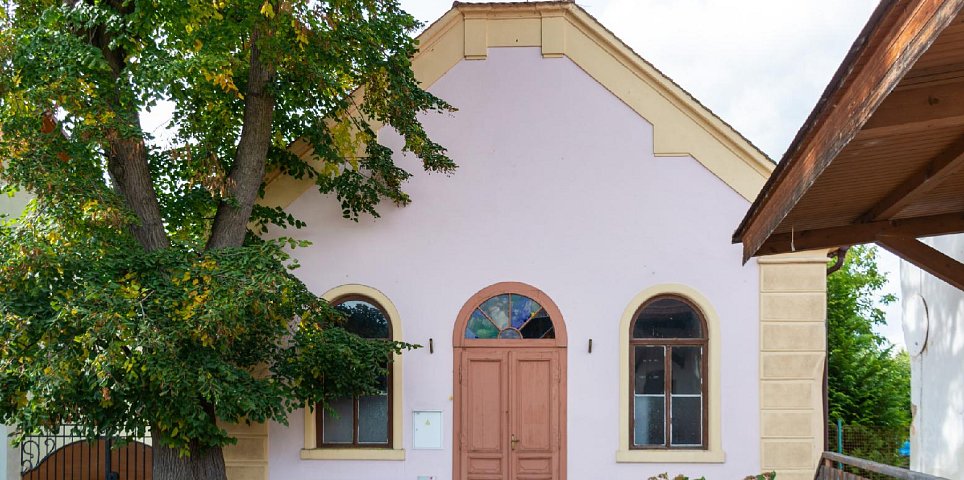
A new, more spacious and modern synagogue was built in 1907 next to the Jewish school building as a replacement for the old, no longer used one.
It is a single-story building without a basement. The roof is gabled with simple tile covering. In the flat-ceilinged prayer hall, decorated before the war with painted stars, there was a wooden floor with an oil finish. The interior furnishings of the synagogue and the appearance of the women’s gallery are unknown. The hall is relatively low, and no traces of the women’s gallery have been preserved, so it is possible that women sat in the hall separated only by a railing.
Services were held there until World War II, probably until the ban on Jewish services in 1941. Cultic objects were transferred in 1942 on the orders of the Nazis from Hluboká nad Vltavou to Prague, where they were stored in the so-called Jewish Central Museum. After the Torah scrolls and all ritual objects were removed, the German army set up a supply workshop in the prayer hall.
The Czechoslovak Hussite Church reportedly used the synagogue from 1945 for its purposes, and in 1948 it obtained it for 25 years on lease. At that time, the roof and plaster were repaired, the passage from the prayer hall to the Jewish school was bricked up, the round window above the original Ark was bricked up, and the sanctuary orientation was rotated 90 degrees. On the eastern façade of the building, above which a stone Decalogue once stood, there is today the symbol of a chalice with a cross and the inscription Husův sbor.
The current entrance was created on the site of the original window of the Jewish synagogue. The building now has its main façade with entrance oriented towards Tyršova Street – the access road from České Budějovice. The original entrance, now bricked up, was located on the south side of the building (today on private land). On the west side, the synagogue adjoins the residential house no. 15 (originally the Jewish school), and from the north, it is bordered by the garden of a neighboring property.
The Jewish cemetery is located 500 meters southwest of the town center along the main road to České Budějovice, between a petrol station and the bank of Munice Pond. It was founded in the mid-17th century and expanded in the 19th century. On its area of 1,275 m², around 190 tombstones from 1752–1941 have been preserved. In the 1990s, toppled modern tombstones were re-erected. Between 2009 and 2012, all historic tombstones were restored, and between 2013 and 2016, the perimeter wall was completely repaired.
Each Jew belonged to the community in whose district he had his regular residence. Each local Jewish religious community had to have a rabbi; exceptionally, one rabbi could serve two communities, but often there was no rabbi at all.
Some regions also played an important role in absorbing two waves of immigration – in 1914, when many Jewish refugees came from Galicia due to the First World War, and after the Sudeten annexation in 1938. Both events affected the composition of the Jewish population. In the case of the second wave, however, they did not return home, as most other Jewish fellow citizens, they perished during the Holocaust. Only a tiny percentage managed to escape racial persecution by emigrating, and even fewer survived the horrors of the concentration camps. Nevertheless, it is still possible to find traces of the descendants of former Jewish communities in many places around the world.
Hluboká nad Vltavou
Hluboká nad Vltavou 373 41


